Question
Where does authority live?
Research lineConstitutional AI & verifiable trust
FOUNDATIONLegitimacy, public authority, non-unilateral amendment and constraints that bind machine action.
SPQR Research
Our research asks what must be true before autonomous systems can act under policy, produce defensible evidence and improve without escaping governance.
The research position
Authority, evidence and execution conditions should be separable from the model generating the proposal, then inspectable by people who did not build the system.
Model proposes · authority verifies · runtime enforces · evidence remainsFour research lines. One operational question.
The corpus moves from jurisprudential questions to concrete system boundaries. Each line asks a different part of the same governance problem.
Legitimacy, public authority, non-unilateral amendment and constraints that bind machine action.
Signed policy state, provenance, active authority and deterministic governance artefacts.
Trusted provenance, mapped operations, fail-closed execution and per-action verdicts.
Auditable proposals, challenge evidence, containment and held-out evaluation rather than invisible self-modification.
Start with a measured claim
Prompt-policy comparator
Reported in the prompt-policy comparator path. This is a proposal endpoint, not an executed-side-effect measure.
Governed sandbox path
Zero observed in the evaluated governed rows. The same path also recorded zero governed mock-tool applications.
Attempted governed decisions
All attempted governed decisions preserved runtime-resolved provenance in this evaluation.
6,300 total rows across 42 tasks, five run families, three conditions and ten repeats per family. Different endpoints must not be presented as a percentage reduction. These results do not establish useful allowed-task completion, universal AI safety or production bypass resistance.
Read the methods and limitations · Review the next evaluation protocol
Start here
These works are the shortest path into the architecture: the runtime boundary, the proof model and the governed-improvement problem.
Bounded claims
Serious governance research should expose its boundaries rather than smuggling confidence through tone.
Public research library
Preprints, working papers and whitepapers are labelled by their public source. Use the filters to move through the research lines.
9 public works shown
A trusted runtime seam between agent proposals and tool effects.
An auditable candidate lifecycle instead of invisible self-modification.
Signed policy state and auditable governance artefacts at the execution boundary.
The broader constitutional-governance thesis and supporting SPQR architecture.
Public participation, action in the absence of authority and plural governance.
Verifiable policy state and non-unilateral amendment as a basis for trust.
Cryptographically enforced machine constraints as operational legal instruments.
Binding, verifiable constraints established at system genesis.
Non-discretionary responsibilities before broader operational freedom.
No papers match that search and filter.
From paper to product
Praxis and Aegis turn the research questions into concrete assurance and control surfaces.
Test what organisational evidence supports, preserve ambiguity and remediation decisions, and establish approved authority.
Explore Praxis →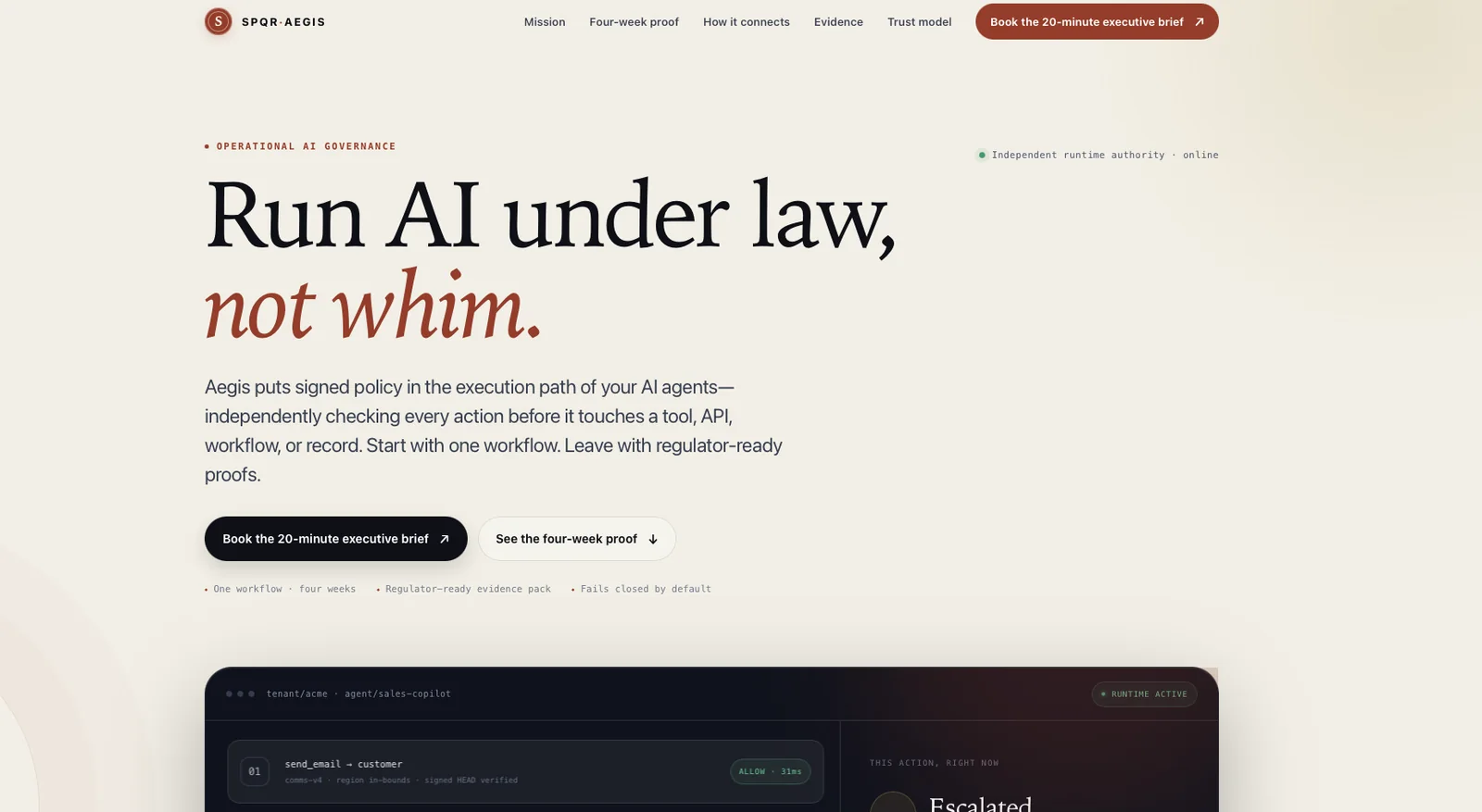
Verify signed active policy state at the action boundary and preserve a per-action decision receipt.
Explore Aegis →One clear next step
Review the proposed protocol before any access is granted. Useful work, false denials, bypass routes and operating cost all belong in the result.
One workflow. Defined scope. A decision about fit.