You bring
The policy documents, organisational scope, baseline/jurisdiction and a named reviewer. Do not send confidential files through the public website.
Praxis Policy Assurance
Assess your policies, standards and procedures against the assigned regulatory baseline, preserve the evidence behind every finding, and turn unresolved obligations into an agreed remediation plan.
For consultancies, MSPs and regulated teams
Start with an agreed policy set and an assigned regulatory baseline. Keep evidence gaps and ambiguity visible; turn findings into a response the consultant and client can review together.
The policy documents, organisational scope, baseline/jurisdiction and a named reviewer. Do not send confidential files through the public website.
A frozen assessment, evidence-linked findings, an obligation register and a remediation workspace. The example shown below is a demonstration, not a promised result.
Consultants and clients inspect, edit and approve recommendations. A remediation draft is not automatically operational policy or runtime authority.
Price, turnaround, baseline coverage and customer effort are agreed for the scope. No automatic compliance claim. Aegis is a separate evaluation, not a required upsell.
See the complete journey
Tier selection, evidence upload, assessment findings, the immutable report, remediation, client collaboration, editing and approval; shown in one film.
From policy estate to governed authority
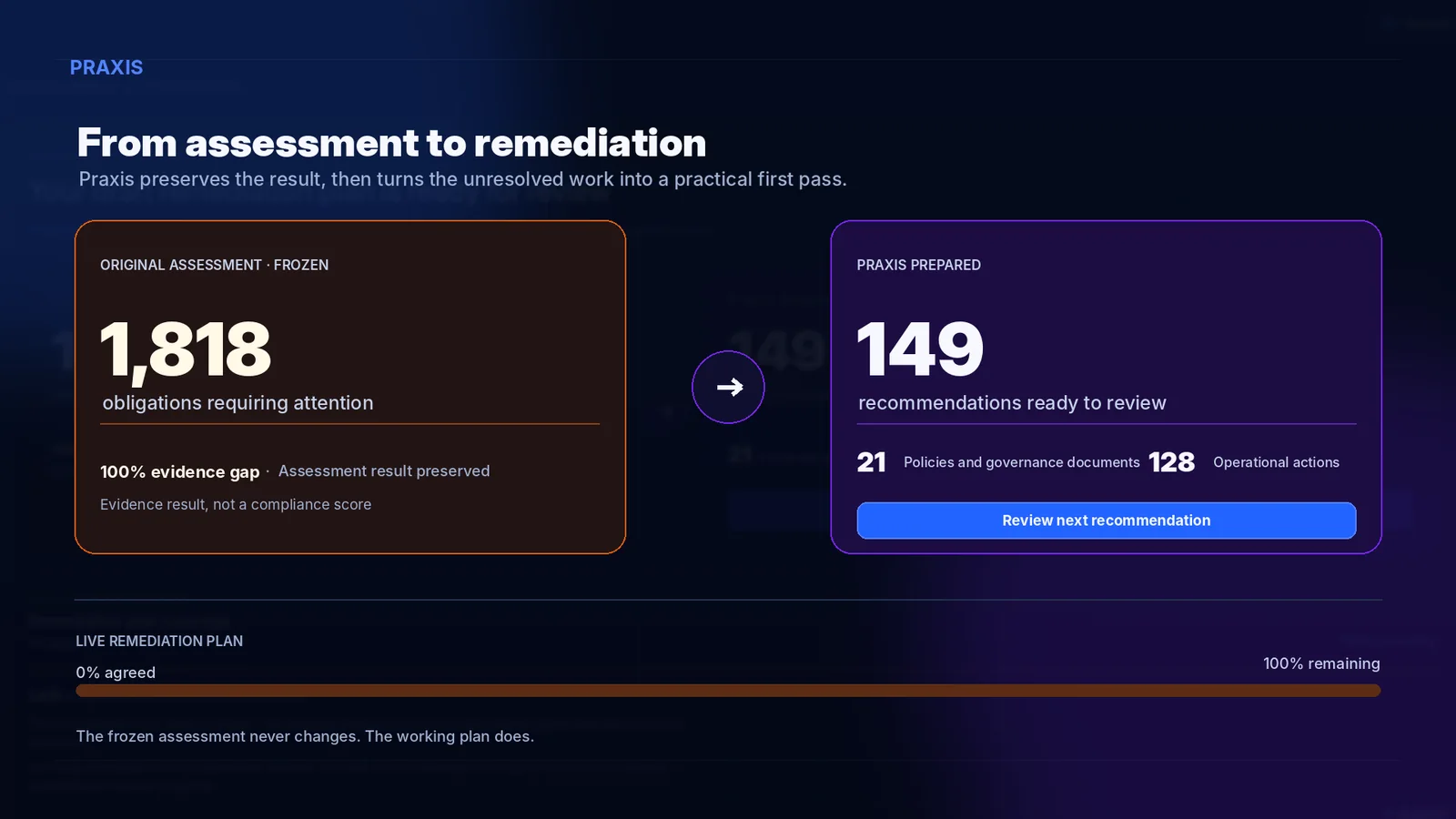
Praxis does not create one document for every obligation. It groups related findings into an organisation-shaped response that people can actually review.
Evidence-bound assessment
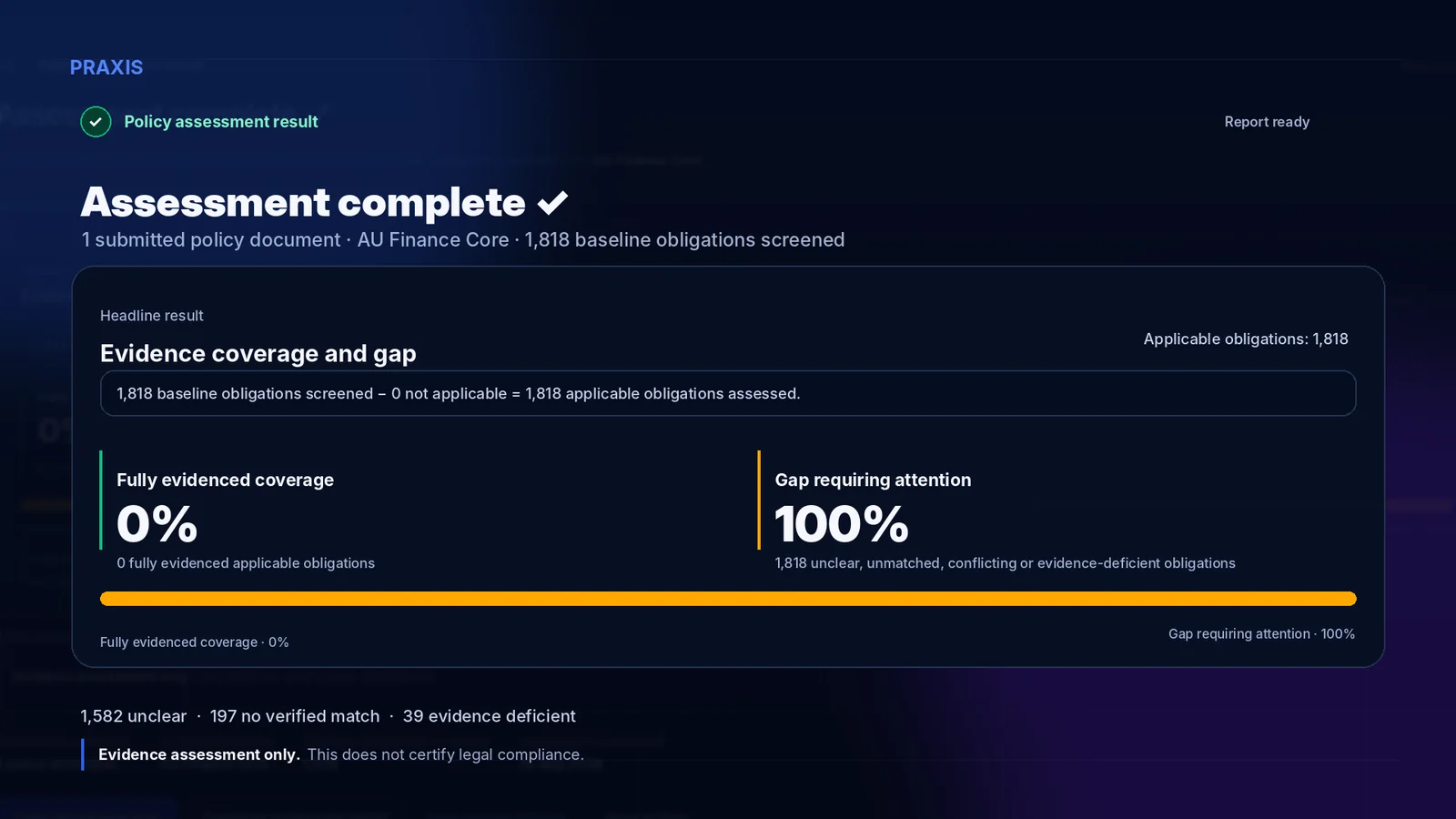
Praxis keeps positive evidence, uncertainty, missing evidence, conflict and applicability separate. The result says what the submitted evidence supports; not more.
Submitted evidence supports the applicable obligation.
Some required elements are supported; others remain unresolved.
No match was verified in the submitted evidence.
The evidence supports more than one defensible reading.
Submitted evidence points to incompatible conclusions.
The required evidence threshold was not met.
The frozen assessment records the obligation as not applicable.
Unknowns remain explicit and are routed to authorised people.
A result somebody can inspect
The professional report, detailed obligation register and source inspection give legal, risk, audit and advisory teams a result they can interrogate rather than simply accept.
The remediation workbench
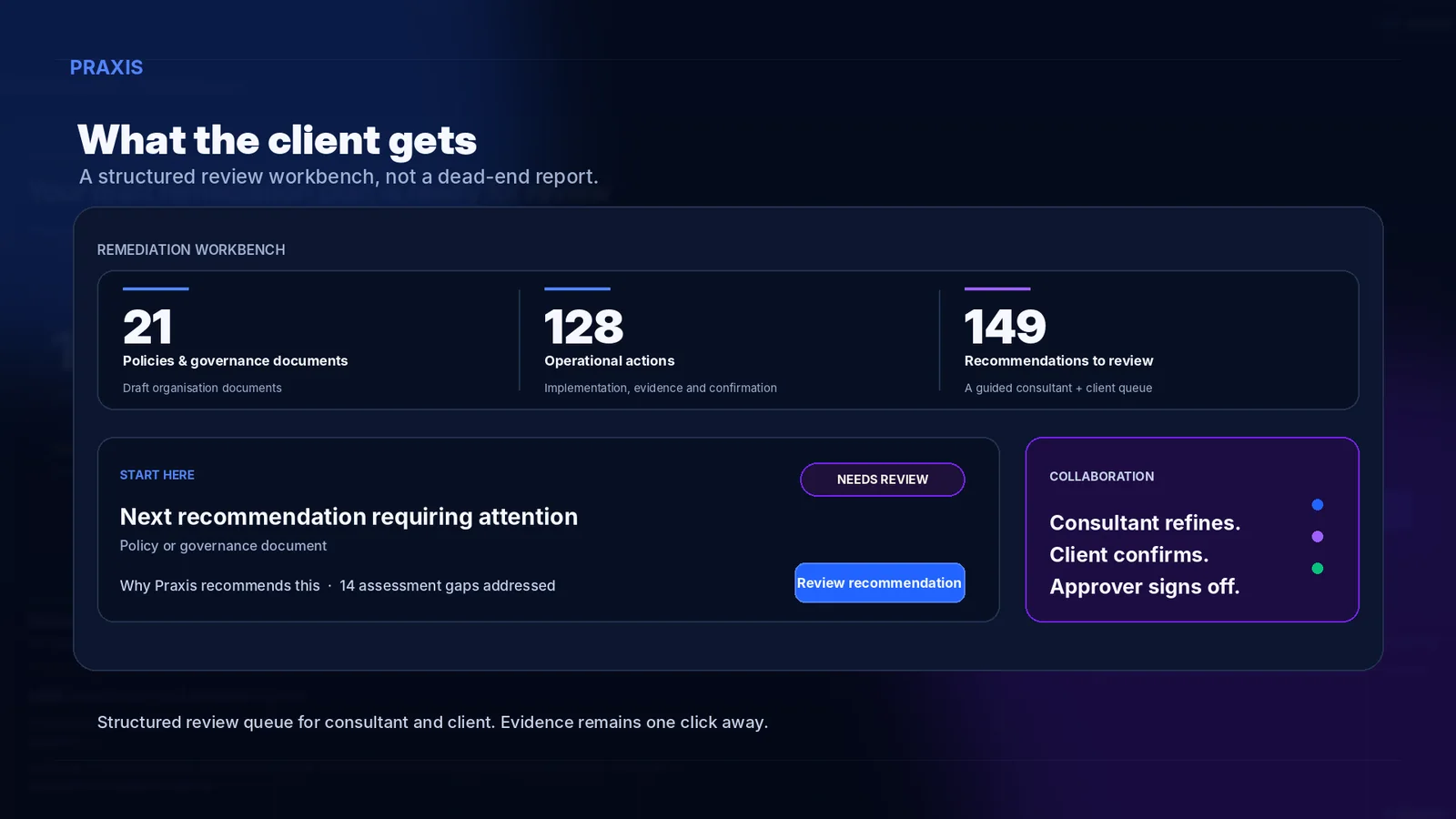
Praxis prepares the practical first pass. Consultants and clients review recommendations, inspect the regulatory basis, ask questions, refine drafts and preserve every revision.
Progress you can feel
As authorised review decisions are recorded, Praxis shows how much of the original assessment scope now has an agreed response.
The line between assessment and runtime
Praxis prepares reviewed governance material. In the SPQR architecture, runtime authority follows explicit approval, compilation, signing and independent Aegis verification. Uploading a policy or accepting a recommendation does not activate enforcement.
Explore the runtime boundaryBuilt for accountable review
For consultancies
Deliver a structured assurance engagement while retaining client ownership, professional judgement and advisory value.
For regulated organisations
See the evidence gaps, understand the work ahead and agree a practical response.
For legal, risk and assurance
Review the regulatory source, evidence, uncertainty and decision history rather than relying on a dashboard claim.
Questions before the call
No. It means a match was not verified in the submitted evidence and assigned scope. Missing evidence, ambiguity, conflict and applicability stay distinct for review.
No. The 1,818-to-149 example is a labelled demonstration outcome. Each engagement depends on the documents, baseline and review decisions.
Authorised consultant and client reviewers make the decisions. The frozen assessment remains unchanged while the remediation response is discussed and agreed.
No. A policy-assurance task can stand on its own. Runtime control is considered only when there is an actual workflow and a relevant authorisation need.
One clear next step
Bring the policy-assurance job, the baseline and the people who will review the findings. We will agree the useful scope before discussing anything larger.
One workflow. Defined scope. A decision about fit.